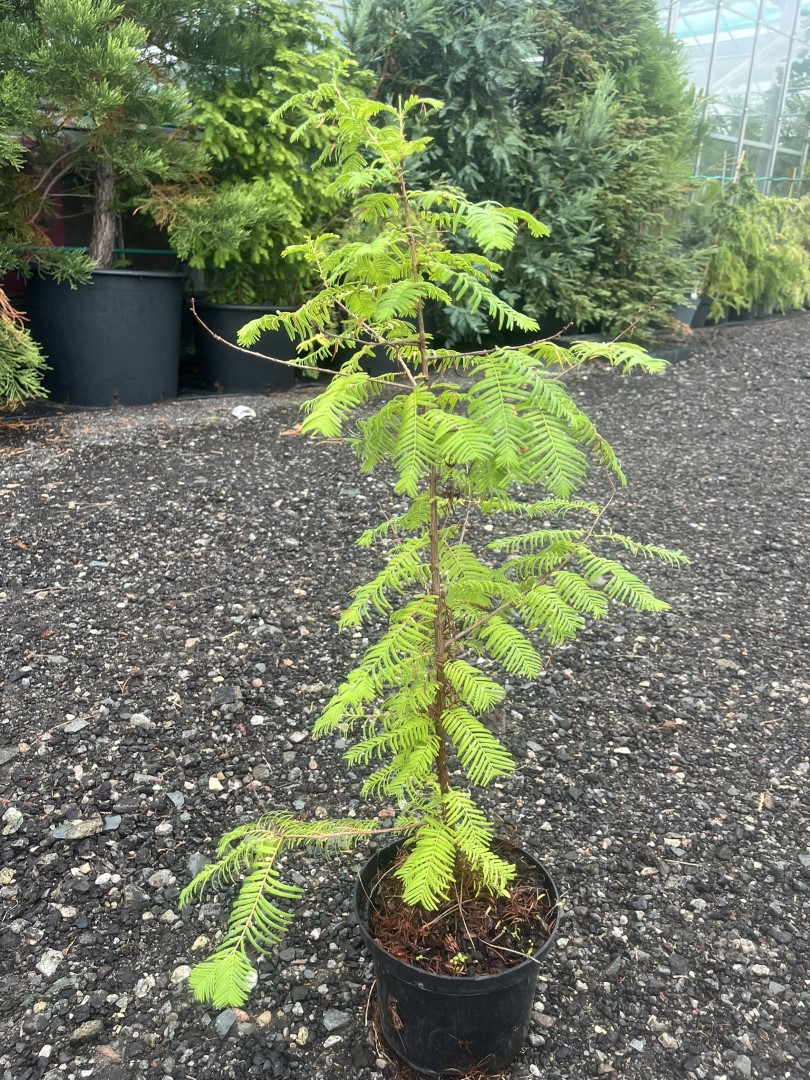

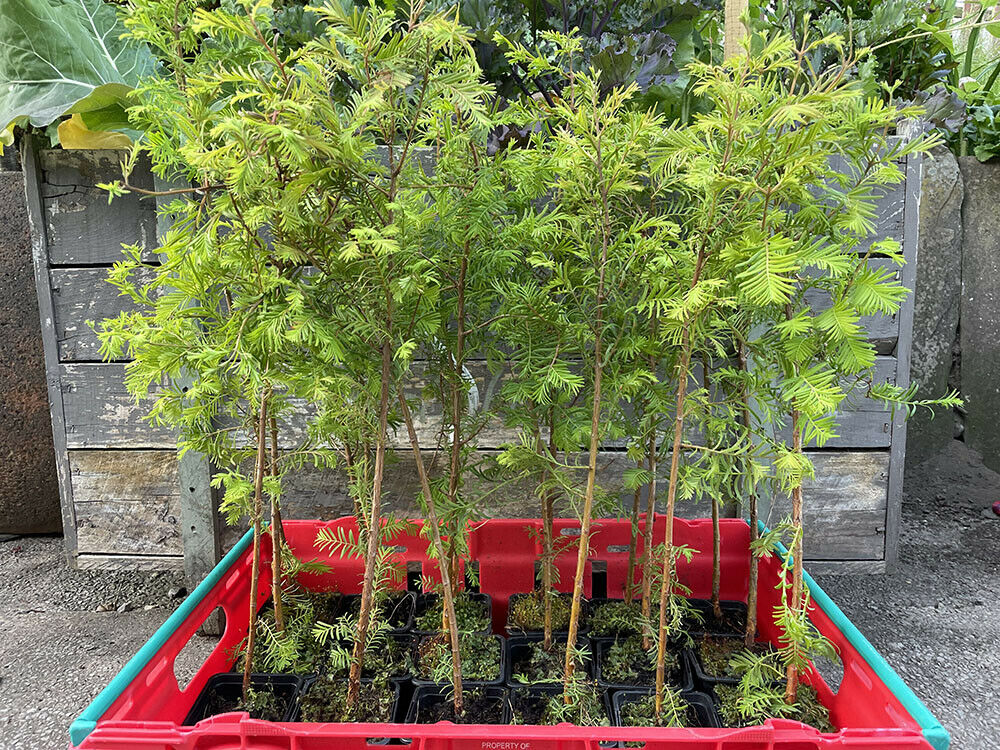
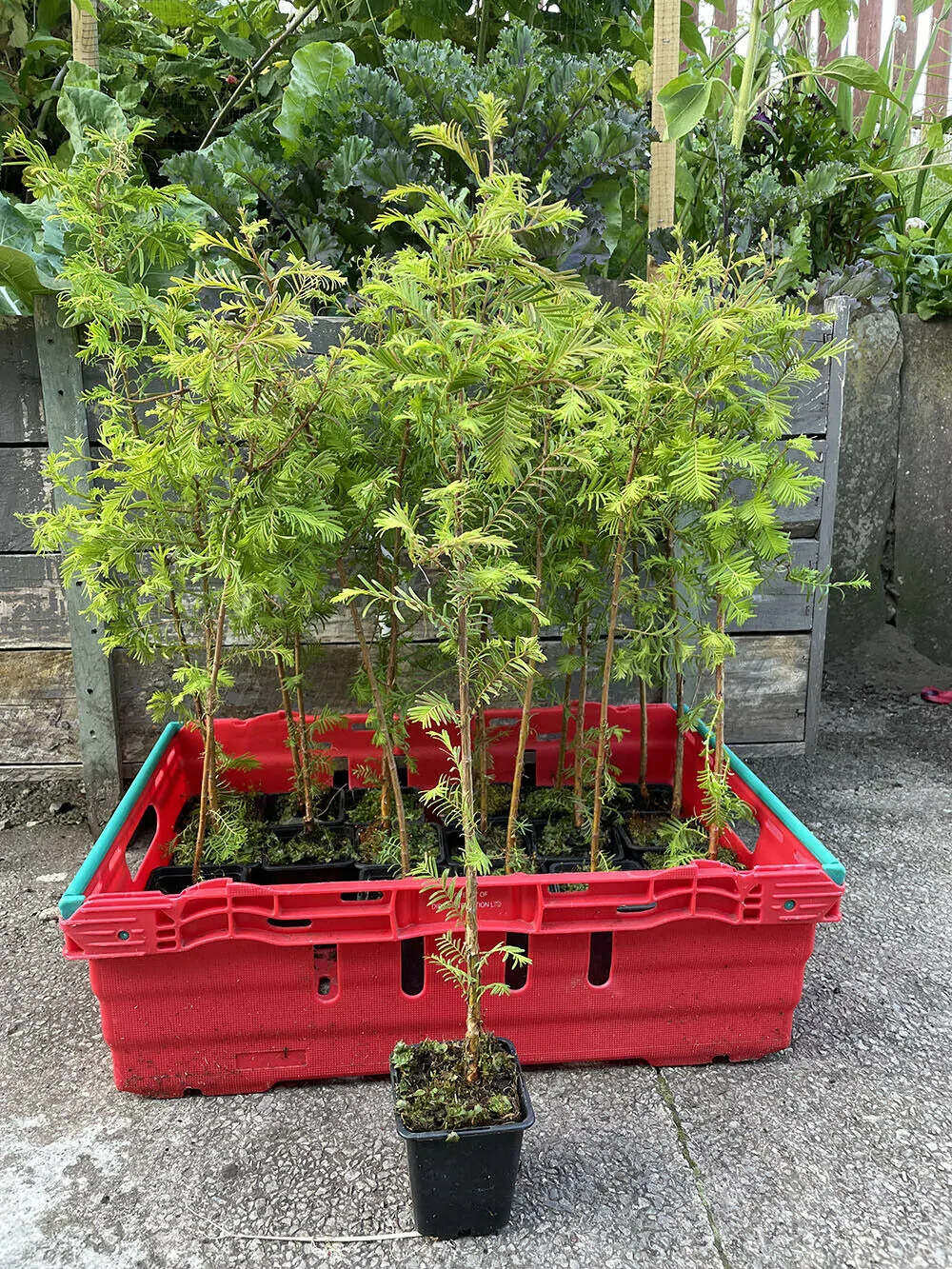

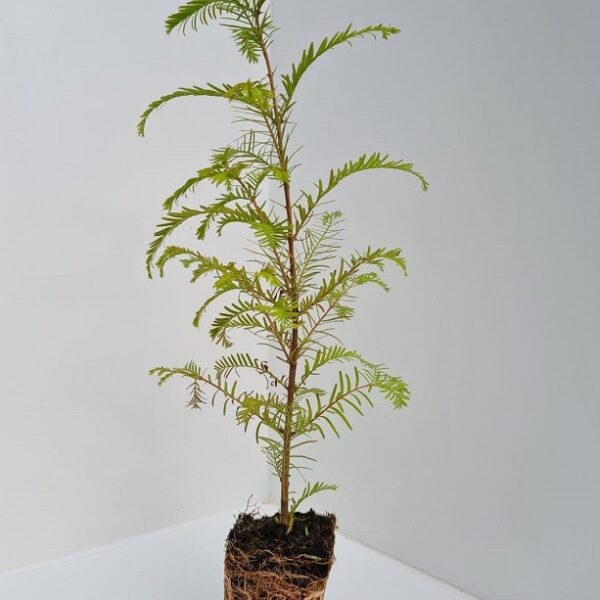
The Dawn Redwood – Metasequoia glyptostroboides is one of the most fascinating conifers you can grow, and this young specimen, supplied at 100–120cm in a 2L pot, gives you the chance to plant a tree with an extraordinary botanical story. Native to central China, the Dawn Redwood is a vigorous, fast-growing deciduous conifer that develops an elegant, narrowly conical shape when young, eventually becoming a magnificent mature tree. Unlike most conifers, it sheds its soft, feathery foliage each autumn, putting on a spectacular display of golden, bronze and rusty-red colour before the leaves fall.
The Dawn Redwood is classified as Endangered on the IUCN Red List of Threatened Species, with its remaining wild population restricted to a small, fragmented area of central China. Its story is one of the most remarkable in modern botany: the genus was known only from fossils and was considered extinct until living trees were discovered in China in the 1940s. The connection between the living trees and the fossil Metasequoia was established in 1946, earning the species its famous reputation as a “living fossil”. Today, it is cultivated in gardens, parks and arboreta around the world, helping to preserve a species with an extraordinary evolutionary history.
The foliage is one of the Dawn Redwood’s most distinctive features. Soft, bright-green leaves are arranged in two opposite rows along the delicate branchlets, giving the tree a wonderfully feathery appearance. In autumn, the foliage turns warm shades of yellow, bronze and rusty red before being shed, revealing the attractive reddish-brown bark beneath. As the tree matures, the bark becomes increasingly rugged and fissured, while the trunk can develop broad, fluted or buttressed roots at its base. Small, rounded cones are produced on established trees.
Planted as a single specimen on a lawn, beside a pond or stream, in parkland or at the end of a long view, the Dawn Redwood makes a superb architectural tree. It is particularly well suited to moisture-retentive ground and, unlike many large conifers, can cope with damp conditions. Rapid growth, elegant form and spectacular autumn colour combine to make it an excellent choice for anyone looking to plant a tree that will become a genuine garden landmark.
Key Facts
- Conservation status: Endangered – IUCN Red List
- Native range: Central China, particularly Hubei, Hunan and Chongqing
- Living fossil: Once believed extinct and known only from fossils before living trees were discovered in the 1940s
- Rediscovered: Living specimens were identified as Metasequoia in China in 1946
- Impressive height: Dawn Redwoods can reach around 50 metres in favourable conditions
- Huge trunk: Mature trees can develop trunks around 3 metres in diameter
- Fast-growing: A vigorous tree capable of making substantial height relatively quickly
- Deciduous conifer: One of the unusual conifers that loses its foliage every autumn
- Autumn display: Soft green foliage turns golden, bronze and rusty-red before falling
- Sole living species: Metasequoia glyptostroboides is the only living species in the genus Metasequoia
- Growth: A long-term specimen tree that needs plenty of space
Care Guide
Choose a site in full sun or light shade with deep, moisture-retentive soil. The Dawn Redwood is particularly well suited to moist ground and can tolerate heavier or occasionally waterlogged conditions better than many large trees. It grows well across Britain and is exceptionally hardy, with the RHS rating the species H7.
Water generously through the first three summers, particularly during dry spells, as young trees establish best when the soil remains consistently moist. A 7–10cm mulch of composted bark or leaf mould applied each spring will help conserve moisture and suppress weeds; keep the mulch clear of the trunk. On poorer soils, a balanced slow-release fertiliser in early spring can support strong, healthy growth.
Pruning is rarely required and is best avoided where possible, allowing the tree to develop its natural conical form. Remove only dead, damaged or crossing branches in late winter. Give the tree plenty of room to develop, particularly away from buildings, drains and boundaries, as it is capable of becoming a very large specimen.
Remember these are the only deciduous redwood – they will drop their needles in Autumn & Winter.
Ultimate height
Higher than 12 metres
Time to ultimate height
20–50 years
Ultimate spread
2.5–4 metres



There are no reviews yet.