



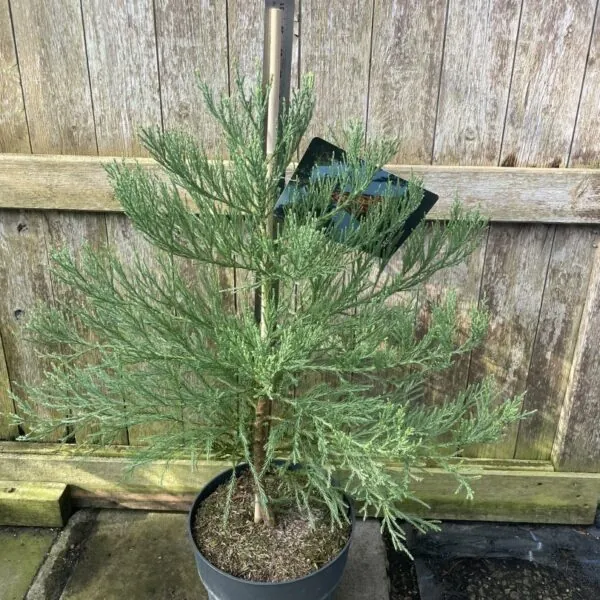
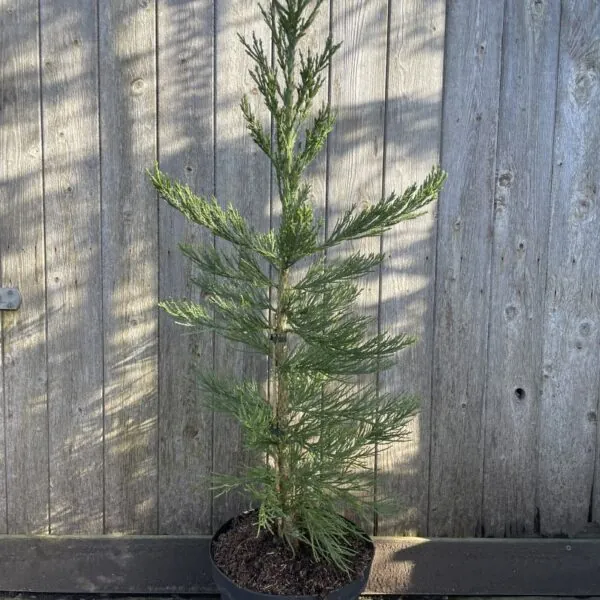
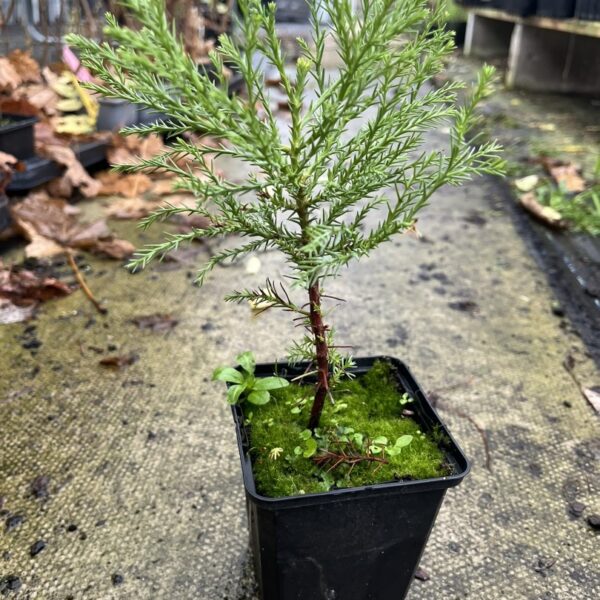
The Giant Redwood – Sequoiadendron giganteum is one of the most impressive conifers you can grow in gardens, and this young specimen, supplied at 60–80cm in a 4L pot, gives you the chance to plant a tree with genuine presence. Native to the western slopes of California’s Sierra Nevada, it ranks among the most massive tree species on Earth and, even in its first few decades, begins to form the broad, conical outline and sturdy trunk that make mature specimens so recognisable.
The Giant Redwood is classified as Endangered on the IUCN Red List of Threatened Species, with its remaining wild population restricted to around 67 groves in California. Its natural habitat is protected in several important areas, including Yosemite National Park, which UNESCO recognises as a World Heritage Site and which contains several groves of giant sequoias. Growing a Giant Redwood in cultivation is a chance to enjoy, and help safeguard, one of the world’s most extraordinary tree species.
The foliage is made up of small, awl-shaped, scale-like leaves that spiral closely around the shoots, giving each branch a soft, rope-like texture. Colour ranges from blue-green to grey-green, deepening slightly through winter, while the foliage releases a faint resinous aroma when brushed. With maturity the bark thickens into a fibrous, spongy layer of warm reddish-brown, split by deep vertical fissures. This remarkable bark provides natural protection from fire in the tree’s native habitat. Small, egg-shaped cones around 4–7cm long appear on established trees and may remain on the branches for several years.
Planted as a single specimen on a lawn, in parkland or at the end of a long view, the Giant Redwood can become a true landmark. It was introduced to Britain in the 1850s, and many Victorian estate plantings still stand today, demonstrating how well it can adapt to our conditions. It needs plenty of room and is not suitable for small gardens or planting close to buildings, drains or boundaries. Given sufficient space, it is relatively low-maintenance, long-lived and tolerant of wind once established.
Key Facts
- Conservation status: Endangered – IUCN Red List
- Native range: Western slopes of California’s Sierra Nevada
- Size: One of the most massive tree species on Earth
- World’s largest tree by volume: The General Sherman Tree is the largest known living tree on Earth by trunk volume
- Impressive height: Giant sequoias can reach around 90 metres in height
- Huge trunk: The General Sherman Tree has a ground circumference of around 31 metres
- 26-storey tree: The largest giant sequoias can grow as tall as an average 26-storey building.
- Lifespan: Can live for more than 3,000 years in the wild
- UNESCO connection: Giant sequoia groves are protected within UNESCO World Heritage sites including Yosemite National Park.
- Growth: A long-term specimen tree requiring plenty of space
Care Guide
Choose a site in full sun or very light shade with deep, moisture-retentive but free-draining soil. The Giant Redwood is particularly happy in the milder, wetter west and south of Britain, where the summer humidity suits it, though it will grow happily across most of the country as long as the ground never dries out badly. Avoid shallow chalk, waterlogged hollows and exposed coastal sites with salt-laden winds.
Water generously through the first three summers, particularly during dry spells, as young plants can be susceptible to drought. A 7–10cm mulch of composted bark or leaf mould applied each spring will conserve moisture and suppress weeds; keep it clear of the trunk. A balanced slow-release fertiliser in early spring will support steady growth on poorer soils.
Pruning is rarely needed and is best avoided, since the natural form is the tree’s chief asset. Simply remove dead, damaged or crossing branches in late winter. It is frost hardy throughout Britain, although late frosts may scorch soft new growth on young plants in colder inland gardens.
Ultimate height
Higher than 12 metres
Time to ultimate height
20–50 years
Ultimate spread
Wider than 8 metres

There are no reviews yet.